
-by Dr. Tim Grivois, Executive Director
The Impact of Frequent Positive Feedback on Behavior Data
If students receive frequent doses of brief, positive, and values-centered feedback throughout the day, what can we expect to see in our behavior data? Nearly always, the answer is a significant reduction in disciplinary referrals.
Why Check-In/Check-Out (CICO) Works
This is why Check-in/Check-out (CICO) works so well:
– Students check in with a coach who helps them make a plan for a successful day.
– Teachers check in and help students stick to their plan.
– At the end of the day, students check out with a coach to debrief the plan and send the student home with a kind, encouraging word.
The Problem with Current CICO Forms
However, what is currently the most common approach to CICO also requires students to carry a form with them. At regularly scheduled periods throughout the day, students meet with teachers to rate their behavior against school values. This form typically tracks how many reminders a teacher issued for behaviors, meaning that at the end of each interval, students get to find out how many times they failed to meet expectations. Then, they get to bring this form to their coach at the end of the day for one more conversation about the data.
Why Forms Aren’t Always Effective
Obviously, students accidentally on-purpose lose these forms. And that’s not even considering students with ADHD participating in interventions like these who are being set up to fail from the outset by asking them to be responsible for one small piece of paper and how it travels to six teachers and their coach throughout the day.
Focusing on What Matters: Coaching Over Forms
CICO works, but not because of the student-facing daily point card. We can create better support for students by focusing on what matters:
- Assign students a coach: Generally, anyone who isn’t a classroom teacher or a principal can do this well.
- Decide how frequently you want students to check in with teachers:
- Elementary schools: Usually after transitions from one subject to another.
- Middle/High schools: Usually at the end of each period.
- Get really good at providing feedback.
Do We Really Need a Form?
If your school is already tracking disciplinary referrals, you probably don’t need to create any kind of form at all. However, if you wanted to keep a closer tab on fidelity, you could consider something like this:
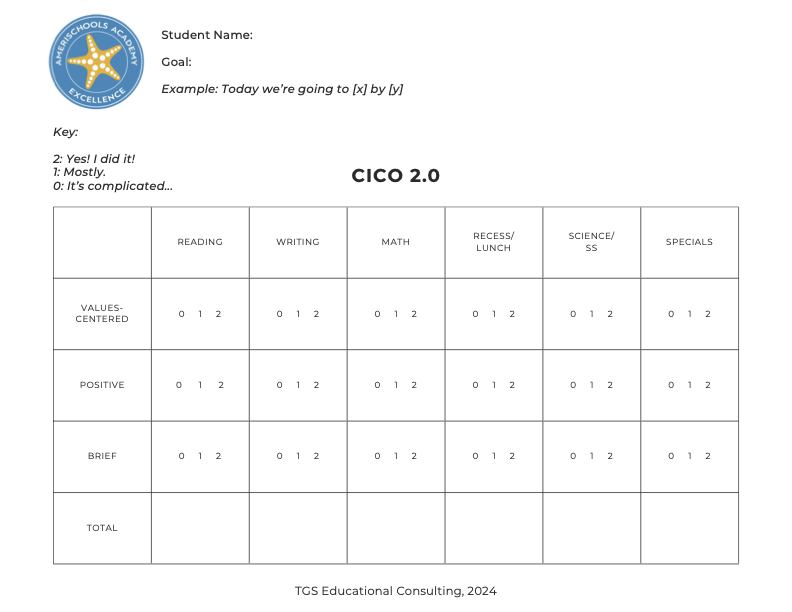
Notice how students never see this form (and so there’s never a form to lose or refuse). All teachers need to do is record whether they had a brief, positive, and values-centered conversation with participating students at the agreed-upon time. Teachers can fill out this form at any time that suits them, making CICO even easier.
The Real Value of CICO: Feedback and Coaching
As far as I know, data on point cards never helped a student reach a goal. When CICO works as a behavior intervention, it’s because:
– Students check in with a coach who helps them make a plan for a successful day.
– Teachers check in and help students stick to their plan.
– At the end of the day, students check out with a coach to debrief the plan and send the student home with a kind, encouraging word.
Interested in Trying This Approach?
I’ll meet with anyone who’d like to give this a try for free. Click here to schedule a time,